Custom ERP vs. Excel Spreadsheets: How Sri Lankan Enterprises Can Automate Operations
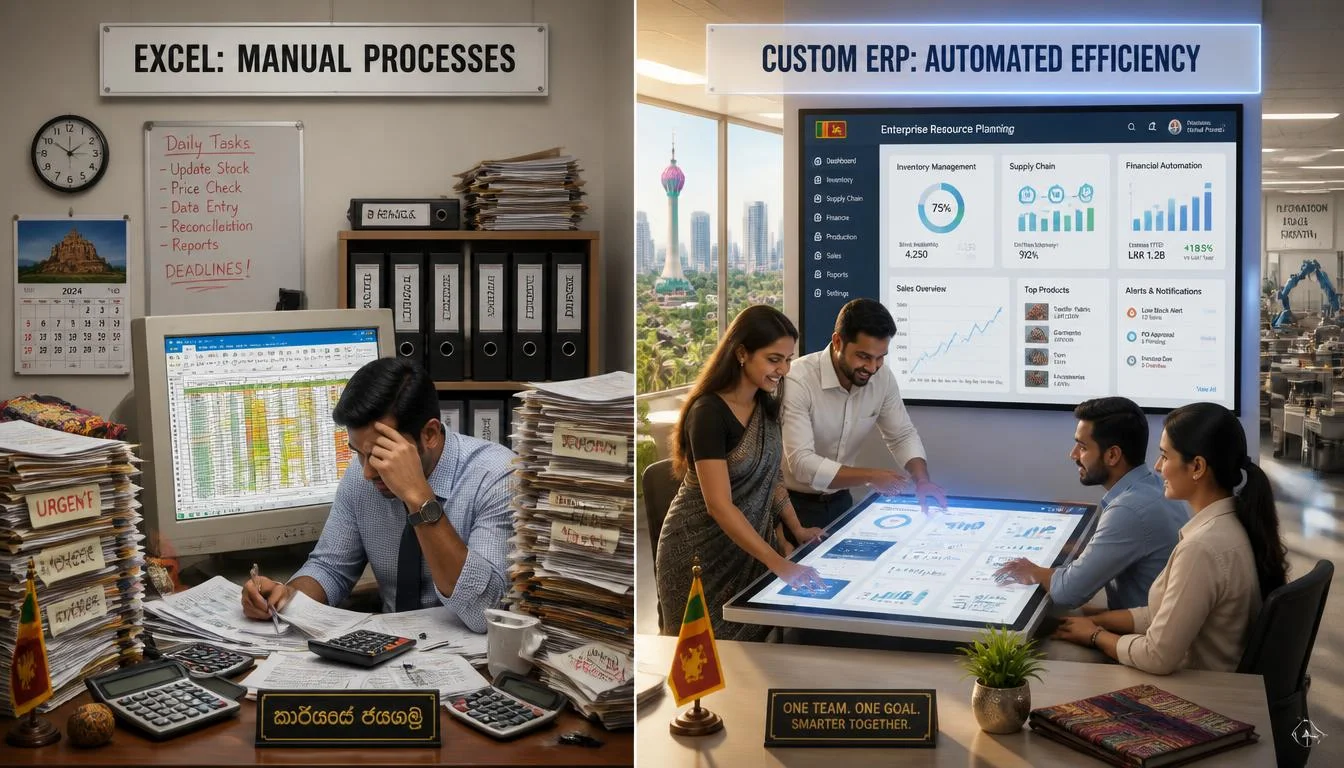
In today’s highly competitive business environment, Sri Lankan enterprises are under increasing pressure to improve efficiency, reduce operational costs, and make faster business decisions. While Microsoft Excel spreadsheets have served businesses for decades as a reliable tool for managing data, they are no longer sufficient for organizations experiencing rapid growth, expanding inventories, multiple departments, and increasing customer demands.
Businesses across manufacturing, wholesale distribution, logistics, retail, healthcare, construction, hospitality, and service industries are now replacing spreadsheets with Custom ERP Sri Lanka solutions that integrate every aspect of operations into one centralized system.
This article explores why modern businesses are moving beyond Excel, the advantages of implementing a warehouse management system in Sri Lanka, and how business software automation enables sustainable business growth.
Understanding the Difference Between Excel and Custom ERP
Excel is an excellent spreadsheet application designed primarily for calculations, reports, and data analysis. It works well for small businesses with limited transactions and straightforward processes.
However, as organizations expand, Excel becomes increasingly difficult to manage because information is scattered across multiple files, departments, and employees.
A Custom ERP (Enterprise Resource Planning) system centralizes all business processes into one intelligent platform where every department works with the same real-time information.
Instead of manually updating dozens of spreadsheets every day, ERP automates operations while improving visibility across the entire organization.
Why Excel Becomes a Business Bottleneck
Many Sri Lankan businesses continue relying on spreadsheets because they appear inexpensive and familiar. However, hidden operational costs increase significantly as businesses grow.
Common challenges include:
- Duplicate data entry
- Human errors in calculations
- Lost spreadsheet versions
- Poor inventory tracking
- Delayed reporting
- No real-time collaboration
- Security vulnerabilities
- Limited scalability
When inventory reaches thousands of products or daily transactions exceed hundreds of records, spreadsheet management becomes inefficient.
Employees spend valuable hours copying, verifying, correcting, and consolidating data instead of focusing on strategic work.
What is a Custom ERP System?
A custom ERP Sri Lanka solution is software specifically designed to match a company’s workflows rather than forcing the business to adapt to generic software.
Unlike off-the-shelf ERP systems, custom ERP solutions are built around existing operational processes.
Modules may include:
- Inventory Management
- Warehouse Management
- Procurement
- Sales
- Customer Relationship Management (CRM)
- Finance
- Accounting
- Production Planning
- Human Resources
- Payroll
- Project Management
- Asset Management
- Reporting Dashboards
Every department shares the same centralized database, eliminating duplicate work and ensuring information remains accurate.
Custom ERP Sri Lanka: Designed for Local Business Requirements
Sri Lankan businesses operate under unique regulatory, financial, and operational conditions.
A locally developed ERP system can accommodate the following:
- VAT calculations
- Inland Revenue compliance
- Local accounting standards
- Multi-currency support
- Sinhala and Tamil language interfaces
- Local banking integrations
- Regional tax requirements
- Sri Lankan payroll regulations
This makes implementation smoother while reducing customization costs compared to international ERP platforms.
Warehouse Management System Sri Lanka: Transforming Inventory Operations
Inventory is one of the most valuable business assets.
Unfortunately, inventory errors are among the most expensive operational problems caused by spreadsheet management.
A warehouse management system in Sri Lanka helps organizations automate warehouse operations from receiving goods to dispatching customer orders.
Core features include the following:
Real-Time Inventory Tracking
Every inventory movement updates instantly.
Managers know exactly:
- Current stock levels
- Reserved stock
- Available inventory
- Incoming shipments
- Outgoing orders
No manual stock reconciliation is required.
Barcode Integration
Barcode scanning dramatically reduces manual entry errors.
Warehouse staff can:
- Receive goods
- Pick products
- Transfer inventory
- Complete stock counts
- Dispatch shipments
within seconds.
Batch and Serial Number Tracking
Businesses handling pharmaceuticals, electronics, food products, or manufacturing materials require detailed product traceability.
ERP systems maintain complete records of:
- Batch numbers
- Manufacturing dates
- Expiry dates
- Serial numbers
- Supplier history
Automated Reorder Levels
Instead of discovering shortages after inventory runs out, ERP systems automatically notify purchasing teams when stock reaches predefined minimum levels.
This reduces:
- Stockouts
- Emergency purchases
- Lost sales
- Customer dissatisfaction
Business Software Automation Eliminates Manual Work
Automation is no longer a luxury.
It has become essential for companies aiming to remain competitive.
Business software automation replaces repetitive manual activities with intelligent workflows.
Examples include:
Automatic Purchase Orders
When inventory falls below reorder levels, purchase orders can be generated automatically.
Invoice Generation
Sales orders instantly produce invoices without re-entering customer information.
Approval Workflows
Managers receive automatic approval requests for:
- Purchase requests
- Leave applications
- Expense claims
- Budget approvals
Customer Notifications
ERP systems automatically send:
- Order confirmations
- Shipment updates
- Payment reminders
- Invoice notifications
Financial Reporting
Instead of manually preparing monthly reports, ERP generates the following:
- Profit & Loss statements
- Balance Sheets
- Cash Flow reports
- Sales analysis
- Inventory valuation
within minutes.
Real-Time Business Intelligence
One of Excel’s greatest limitations is outdated reporting.
By the time spreadsheets are consolidated, information may already be inaccurate.
ERP dashboards provide instant insights, including:
- Daily sales
- Revenue performance
- Inventory turnover
- Customer trends
- Employee productivity
- Warehouse efficiency
- Procurement costs
- Financial performance
Executives can make informed decisions using current business data rather than historical spreadsheets.
Enhanced Collaboration Across Departments
Departments often maintain separate Excel files.
Sales has one spreadsheet.
Finance has another.
Warehouse uses another version.
Purchasing keeps independent records.
This creates inconsistencies and communication problems.
ERP connects every department through a centralized database where information updates immediately.
When Sales creates an order:
- Inventory updates automatically.
- Finance generates invoices.
- Warehouse prepares shipments.
- Procurement receives replenishment alerts.
Everyone works from the same source of truth.
Improved Data Security
Excel files are frequently stored on:
- Personal computers
- USB drives
- Shared folders
- Email attachments
This increases security risks.
ERP systems offer:
- User authentication
- Role-based permissions
- Activity logs
- Automated backups
- Cloud security
- Data encryption
Sensitive business information remains protected while maintaining controlled employee access.
Scalability for Growing Businesses
Businesses that begin with five employees often grow into organizations with hundreds of staff members.
Excel struggles with:
- Large databases
- Concurrent users
- Complex reporting
- Multi-location operations
Custom ERP systems scale alongside business growth without requiring complete operational redesign.
Whether managing one warehouse or twenty, the same system continues supporting expansion.
Industries Benefiting from Custom ERP Sri Lanka
Virtually every industry benefits from ERP implementation.
These include:
Manufacturing
- Production planning
- Raw material management
- Quality control
- Machine maintenance
Wholesale Distribution
- Order processing
- Stock management
- Route planning
- Supplier management
Retail
- Point of Sale integration
- Inventory synchronization
- Customer loyalty
- Sales analytics
Logistics
- Fleet tracking
- Shipment monitoring
- Warehouse operations
- Delivery management
Healthcare
- Patient management
- Medical inventory
- Billing automation
- Appointment scheduling
Construction
- Project costing
- Equipment management
- Procurement
- Contractor tracking
Cost Savings Through ERP Automation
Although ERP implementation requires an initial investment, long-term savings significantly outweigh costs.
Businesses reduce expenses by minimizing the following:
- Manual labor
- Inventory losses
- Data duplication
- Administrative overhead
- Paper documentation
- Operational delays
- Accounting errors
- Customer service issues
Many organizations recover ERP investments through improved operational efficiency within a relatively short period.
Signs Your Business Has Outgrown Excel
If your organization experiences any of the following, it may be time to invest in a custom ERP Sri Lanka solution:
- Multiple versions of spreadsheets
- Frequent inventory discrepancies
- Manual report preparation
- Slow order processing
- Data entry duplication
- Delayed financial reporting
- Poor visibility across departments
- Difficulty tracking customer orders
- Increasing employee workload
- Limited business insights
These challenges indicate operational processes have become too complex for spreadsheets alone.
How to Choose the Right ERP Partner in Sri Lanka
Selecting the right ERP provider is as important as choosing the software itself.
Look for a technology partner that offers:
- Industry-specific experience
- Local implementation support
- Custom software development
- User training
- Ongoing maintenance
- Cloud deployment options
- Data migration expertise
- Integration with existing systems
- Scalable architecture
- Strong customer support
A reliable ERP partner ensures smooth implementation while minimizing business disruption.
The Future of Business Software Automation in Sri Lanka
Digital transformation is accelerating across Sri Lanka as businesses embrace automation, cloud computing, artificial intelligence, and data-driven decision-making. Organizations that continue relying solely on spreadsheets risk slower growth, higher operating costs, and reduced competitiveness.
A custom ERP Sri Lanka platform combined with a modern warehouse management system in Sri Lanka provides the foundation for streamlined operations, accurate reporting, improved customer service, and sustainable expansion. By replacing disconnected spreadsheets with integrated business software automation, enterprises gain greater visibility, stronger control over resources, and the agility needed to adapt to changing market demands.
Businesses that invest in intelligent automation today are better positioned to improve productivity, reduce errors, optimize inventory, and deliver exceptional service while building a resilient operation ready for the future.
Conclusion
Excel remains a valuable tool for simple calculations and small-scale data management, but it cannot support the operational complexity of modern enterprises. As organizations grow, disconnected spreadsheets create inefficiencies, increase the risk of costly errors, and limit visibility across departments.
A custom ERP Sri Lanka solution transforms business operations by connecting finance, inventory, sales, procurement, human resources, and warehouse management into one centralized platform. When paired with a powerful warehouse management system in Sri Lanka, businesses can automate workflows, monitor operations in real time, strengthen data security, and improve decision-making through accurate insights.
The shift toward business software automation is no longer just a technological upgrade—it is a strategic investment that empowers Sri Lankan enterprises to scale confidently, improve operational excellence, and maintain a competitive advantage in an increasingly digital economy.